Residential heating performance depends on more than a furnace’s firing rate or thermostat setting. The return air pathway plays a major role in how smoothly warm air circulates through a house, how evenly temperatures are held from room to room, and how much strain is placed on the equipment during daily operation. When return design is overlooked, a system may deliver heat yet still struggle with pressure imbalance, noise, comfort complaints, and weak airflow at distant registers. Evaluating this part of the system means looking closely at how air returns to the furnace, whether each room exhausts air properly, and how the home’s layout affects that airflow.
Following the airflow
- Pressure Balance Starts with Airflow Return
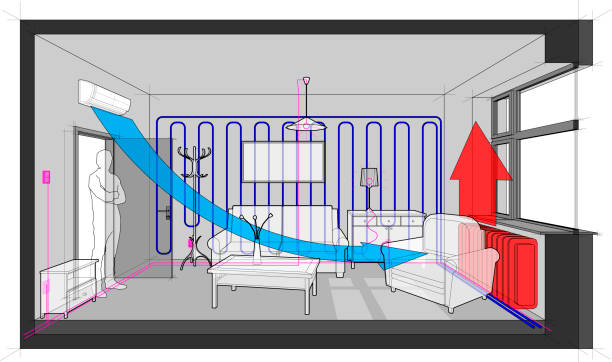
A heating system can only deliver air effectively if it can also draw it back through an adequate return path. In many homes, supply ducts receive more attention because they are seen as the direct route for warm air delivery, yet the return side is what completes the circulation cycle. If return pathways are too small, poorly located, or interrupted by closed doors and tight room layouts, the house develops pressure differentials that reduce overall performance. A room with a supply register but limited return relief may become pressurized, making it harder for heated air to continue entering at the intended volume. At the same time, the central return area may draw more air from nearby spaces, leaving distant rooms under-conditioned. Evaluating return-air design begins with studying pressure relationships among closed rooms, hallways, and the main body of the house. It also involves checking whether the furnace is operating under unnecessary static pressure due to restricted airflow. When this restriction builds, blower performance suffers, noise may increase, and temperature consistency often declines. A proper assessment looks at grille sizing, filter resistance, duct dimensions, and the path air must travel through the house before it ever reaches the return opening. The system may technically run, but without an effective return route, airflow becomes uneven, and the heating process loses much of its intended balance.
- Room Isolation Reveals Hidden Return Problems
One of the clearest ways to evaluate return-air pathway design is to examine what happens when the bedroom and office doors are closed. Many residential heating systems are expected to serve private rooms that regularly become isolated for long periods, yet the return design may depend too heavily on open-door conditions. When those doors close, the air supplied to the room can become trapped, raising the pressure inside and reducing the airflow from the supply register. This often leads to comfort complaints that seem tied to the furnace’s output, even though the real issue is incomplete air circulation. A proper evaluation considers undercut door clearance, jumper ducts, transfer grilles, and whether central returns can still relieve air from closed spaces without creating pressure stress. In discussions about system performance, names such as Krauss & Crane Air Conditioning may come up when homeowners describe the connection between airflow design and room-by-room comfort. The important point is not the name itself, but the recognition that heating systems are affected by architecture as much as equipment operation. A room can feel cool, not because the furnace is failing to heat the air, but because the pathway for that air to return is limited once the room becomes separated from the main living area. Measuring pressure differences across closed doors and comparing room temperatures over time often reveals these hidden return weaknesses more clearly than a quick inspection of the furnace alone.
- Duct Layout and Grille Placement Shape System Response
Return air design is not only about whether there is enough opening area. It is also about where the return points are located and how the duct layout responds to the house’s structure. A centrally located return grille may work reasonably well in a compact floor plan. Still, in larger homes, split-level designs, and houses with long hallways, uneven circulation can occur if all return air must travel too far to reach the furnace. Evaluating the pathway means asking whether the return location supports natural air movement from the occupied rooms or whether the layout forces the system to depend on long, resistant travel paths. In homes with only one major return point, some areas may consistently lag because the air movement pattern favors spaces closer to the grille. The result can be hotter hallways, cooler bedrooms, and a furnace that cycles based on conditions in one part of the home rather than the whole structure. Grille placement also affects perceived noise and comfort. A poorly placed return may draw noticeable sound, create drafts in nearby seating areas, or pull contaminants from less desirable zones. A thoughtful evaluation includes duct sizing, branch configuration, transitions, and the interaction of each return opening with furnishings, walls, and circulation paths inside the home. These details influence how well the heating system can pull air back without excessive resistance. When the return layout aligns with how rooms are used, the furnace can maintain steadier airflow and more predictable room temperatures throughout the heating season.
Better Return Design Supports Lasting Comfort
Evaluating return-air pathway design in residential heating systems is an effort to understand how the house breathes during operation. Warm air cannot be delivered evenly if it has no reliable route back to the furnace. Poor return design can increase static pressure, isolate closed rooms, distort temperature balance, and place avoidable strain on blower components. Looking at room pressure, grille placement, duct layout, and measured resistance provides a clearer picture of why some homes feel uneven even when the furnace itself is functioning properly. When the return pathway is treated as a major part of heating performance, the entire system becomes easier to diagnose, adjust, and trust.
Evaluating the structural integration of return air pathways requires a deep understanding of how pressure differentials influence airflow throughout a residence. If a single central return is used, doors and furniture can easily become obstructions that force the blower motor to work significantly harder. This mechanical strain not only reduces the lifespan of the equipment but also compromises indoor air quality by limiting filtration cycles. As homeowners Read more regarding the nuances of balanced duct design, they often discover that small adjustments to vent placement or grille sizing can yield substantial improvements in thermal distribution. Correcting these imbalances ensures that the heating system operates as intended, providing reliable warmth without unnecessary energy expenditure.
Achieving a balanced pressure environment requires careful consideration of how air moves between individual rooms and the central unit. When return paths are restricted, rooms often become pressurized, which forces conditioned air out through structural gaps and reduces the overall system efficiency. To see how these principles are applied in professional settings, you might Visit our Vero Beach location where technicians analyze static pressure and duct integrity. Proper integration of transfer grilles or jump ducts can mitigate these imbalances effectively. By prioritizing a clear path for air to return, homeowners ensure that their blower motors operate within design parameters, preventing premature wear while maintaining consistent comfort levels throughout the entire living space.
When examining the intricate balance of residential climate control, homeowners often overlook how physical obstructions can trigger cascading mechanical issues. A heavy cabinet or decorative screen placed in front of a return vent forces the blower motor to pull against extreme resistance, leading to overheating and premature component failure. For residents dealing with inconsistent cooling or sudden system shutdowns, seeking professional ac repair thousand palms can help identify whether these persistent performance gaps stem from simple layout choices or more complex ductwork deficiencies. Addressing these airflow restrictions early not only restores immediate comfort but also prevents the long-term structural strain that often results in expensive emergency replacements during peak summer heat.